Your complete destination for Penlink training, with live sessions, on-demand modules, and certifications designed to give professionals the tools and confidence to succeed in real investigations.
CoAnalyst for PLX: Turning Digital Evidence into Decisive Action
Date Posted: April 30th, 2026
By Kaitlyn Ziola and Udi Levy
Investigators today are not dealing with a shortage of data. They are dealing with too much of it. Communications, location records, transactions, open-source intelligence, financial data: modern cases are shaped by volume and velocity, and the challenge is no longer access. It is making sense of what you have, quickly and accurately. CoAnalyst for PLX was built to meet that challenge directly.
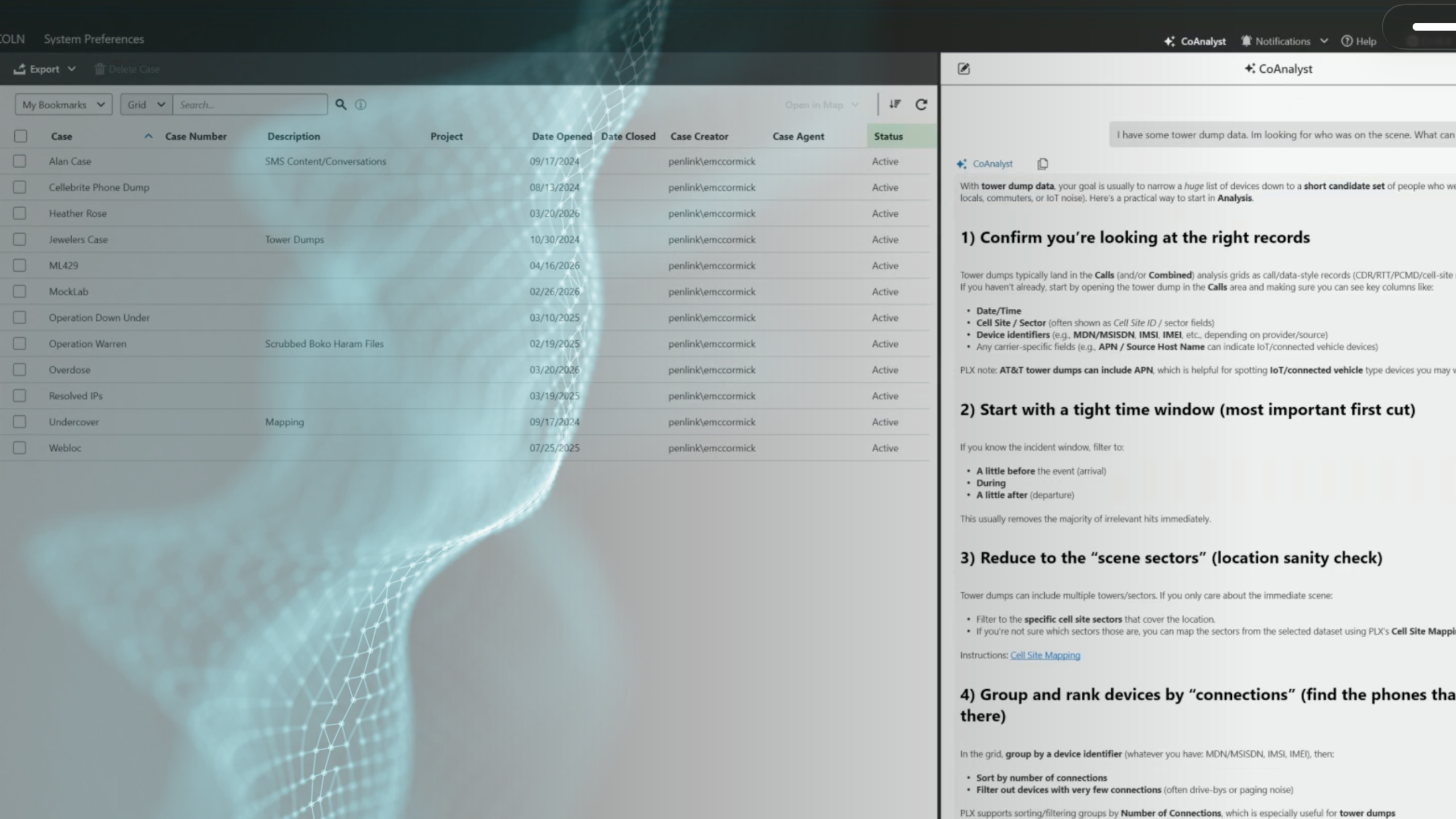
Purpose-built for law enforcement and shaped by real investigative workflows, CoAnalyst brings generative AI directly into PLX to help investigators move faster from fragmented data to meaningful insight. The capability continues to evolve, and input from the field remains central to ensuring it delivers practical, real-world impact for the agencies that rely on it.
From Fragmented Data to a Clearer Picture
PLX has long given investigators a powerful environment for analyzing communications and evidence. CoAnalyst adds an intelligent layer to that environment, one that brings structure to complexity without requiring investigators to leave the tools they already know.
Rather than manually connecting dots across systems, investigators can begin to see relationships, timelines, and key details take shape more quickly. The goal is not to replace investigative judgment. It is to reduce the time spent on lower-value tasks so that judgment can be applied where it matters most.
For agencies working high-volume cases, that shift is significant. It redefines how quickly teams can move from raw data to actionable intelligence.
Built for Evidentiary and Investigative Workflows
CoAnalyst is not a general-purpose AI tool adapted for law enforcement. It is designed specifically for evidentiary and investigative workflows, with input from law enforcement professionals who understand the stakes, complexity, and precision these cases require.
That collaboration does not stop at launch. As agencies begin using CoAnalyst within PLX, their feedback plays a direct role in refining and advancing the capability. This is an evolving tool, one that grows stronger through real-world use and partnership with the professionals it serves.
Additionally, because CoAnalyst is embedded directly into PLX, investigators work within a familiar environment rather than switching between systems. The workflow stays intact. The time savings are immediate.
Speed Without Sacrificing Investigative Rigor
In modern investigations, time is critical. But speed without control introduces risk. CoAnalyst is designed to deliver both, through an analyst-in-the-loop approach that keeps investigators at the center of every workflow.
AI handles the processing: correlating large datasets, surfacing patterns, and summarizing complex information. Investigators guide interpretation, validate findings, and make final decisions. The result is a more efficient process that maintains the rigor and defensibility agencies depend on.
In high-volume cases, this can mean the difference between weeks of manual review and actionable direction in hours. Investigators can act sooner, build stronger cases, and deliver better outcomes for their agencies and communities.
Transparency and Auditability at Every Step
Introducing AI into investigative workflows requires more than capability. It requires trust. Investigator oversight remains central to the process. Outputs are clearly distinguished from source data, and workflows are designed to support transparency, auditability, and defensibility.
These are not optional features. They are foundational to how CoAnalyst was built, because findings produced through AI-assisted analysis must hold up to the same scrutiny as any other evidence in a case.
Furthermore, as agencies begin to trial CoAnalyst within PLX, early adopters play a key role in shaping what comes next. Real-world use surfaces real-world needs, and that feedback loop is how the capability continues to improve.
CoAnalyst for PLX is available now. For agencies navigating increasing data complexity, it is a practical step toward faster insight, greater investigative clarity, and stronger outcomes.
To see how CoAnalyst works within PLX, Request a demo and explore what’s possible for your agency.
The Penlink Training Summit returns to Omaha, Nebraska, March 8–10, 2027, bringing together investigators, analysts, agency leaders and security professionals for two and a half days of training, learning and collaboration.
Europol brought together investigators, analysts and open-source intelligence specialists from 12 countries for a four-day operation targeting human trafficking networks exploiting Ukrainian nationals online.
Penlink, a leading provider of digital intelligence solutions for law enforcement, national security, defense and enterprise organizations, announced today that Training Manager Brittany Hansen was presented with the Patriot Award from the Employer Support of the Guard and Reserve (ESGR), a Department of War program.
Chicago police and the U.S. Marshals Service teamed up this spring. Their goal: find missing juveniles fast. Over ten days in May, Operation Safe Return Chicago located 30 missing kids across the city.
A Lake County, Florida jury found two men guilty on drug trafficking and related charges tied to a 2022 investigation into narcotics sales across the Leesburg, Mount Dora, and Fruitland Park area.
The Department of Homeland Security announced the results of a nationwide crackdown on human trafficking coordinated around the 2026 FIFA World Cup. Homeland Security Investigations (HSI), the DHS Center for Countering Human Trafficking, and federal, state, and local partners arrested 905 suspects and rescued 180 victims — 150 adults and 30 juveniles — across World Cup host cities.