







Explore Cases Government Cyber Crimes
Ransomware Infrastructure Attribution
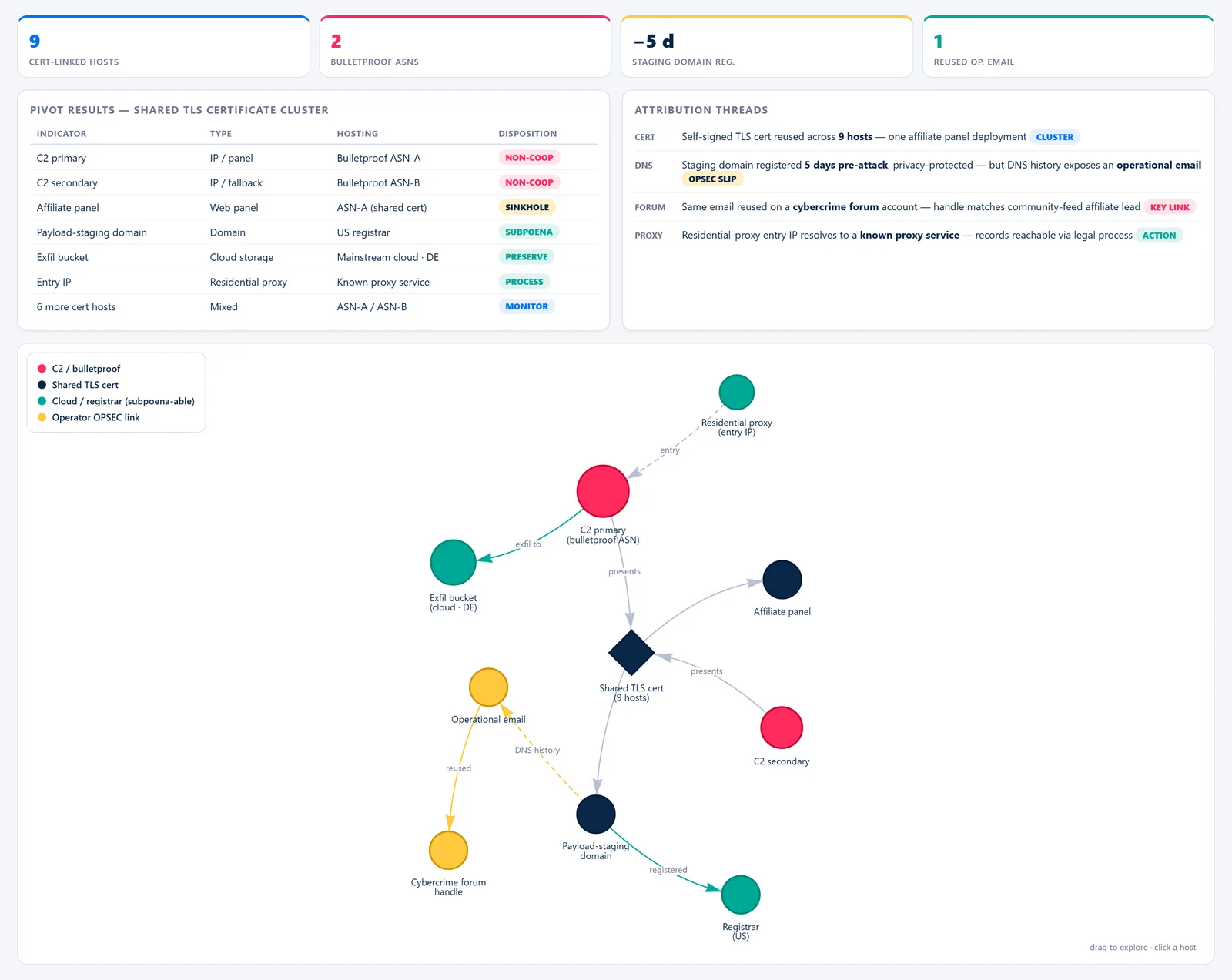
The forensic timeline explains how the ransomware moved through the victim network. Attribution begins outside it. Certificates, passive DNS, staging hosts, leak-site infrastructure and operator mistakes can connect the intrusion to a wider footprint—and show whether the evidence supports a known group, a new cluster or neither.
Capabilities
Overview
Incident response establishes what happened inside the victim environment. Attribution requires a second layer of evidence from outside the perimeter: infrastructure history, certificates, registrations, threat-intelligence reporting, leak-site material and tradecraft that can be compared with other known activity.
CoAnalyst360 keeps those internal and external evidence sets connected. Forensic artifacts can be organized into a kill-chain timeline, then used as pivots into related infrastructure and external reporting. Analysts can compare the resulting cluster with known activity and document both supporting and contradictory evidence. The result is an attribution assessment with an inspectable chain of reasoning rather than a vendor label attached to a list of indicators.


Key features
- Forensic artifact parsing Ingest endpoint, firewall and authentication logs and normalize them into one ordered sequence of events across otherwise incompatible sources.
- Kill-chain reconstruction Map observed behavior to kill-chain phases from initial access through impact, producing a defensible timeline rather than a log excerpt.
- Indicator enrichment Cross-reference indicators against threat-intelligence feeds, sandbox reports, public reporting and leak-site material to place the intrusion against known activity.
- Infrastructure pivoting Pivot from command-and-control addresses through TLS certificates and passive DNS to surface related hosts the intrusion itself never touched.
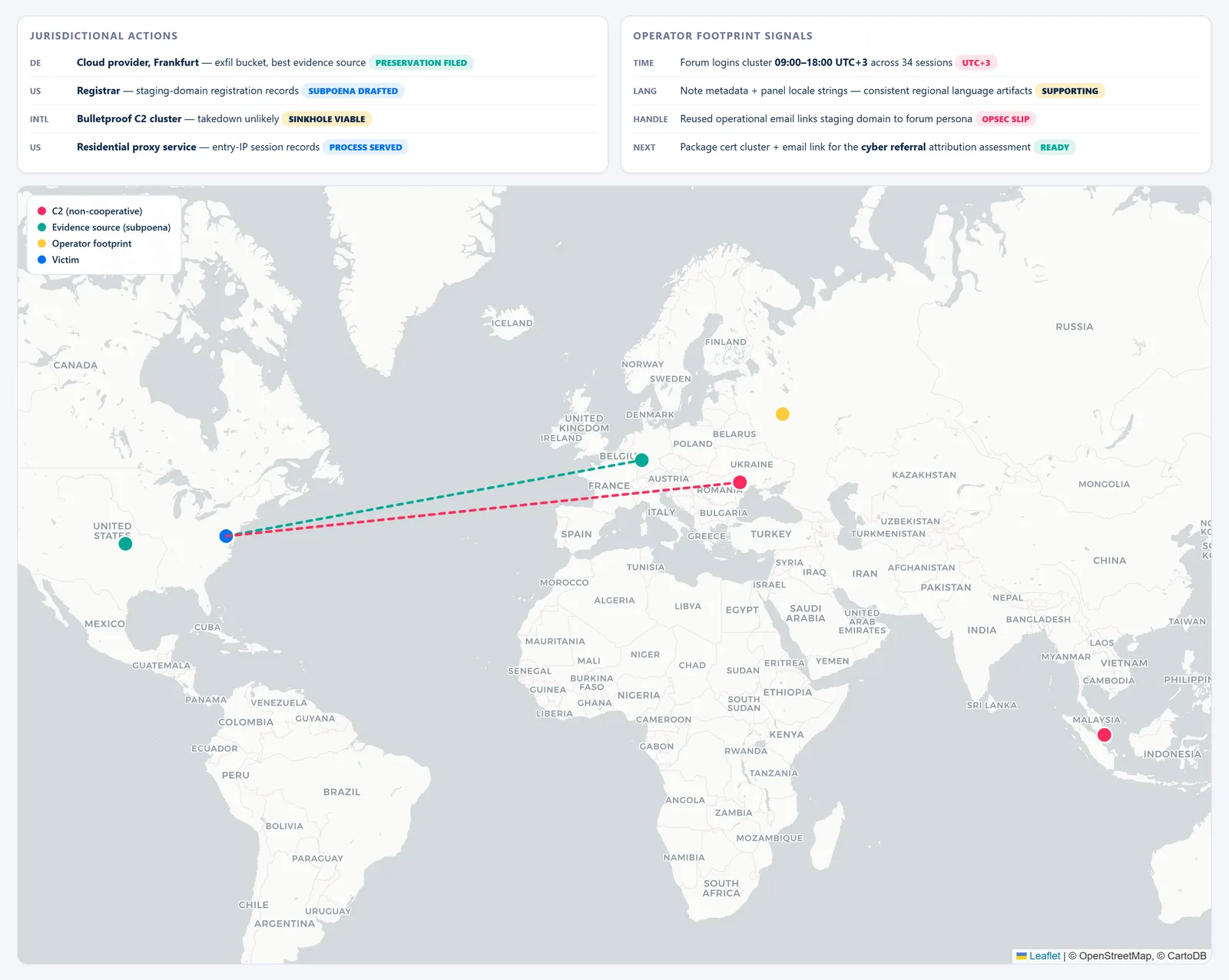
- Infrastructure geolocation Place command-and-control, staging and exfiltration infrastructure geographically to show the shape and reach of the footprint — without treating hosting location alone as attribution.
- Operator tradecraft analysis Analyze activity timing, tooling and language artifacts for operational-security lapses that narrow attribution beyond the infrastructure itself, and carry a confidence rating with the finding.
See CoAnalyst360 on your own data
Bring your existing data sources into a coordinated investigative workflow. See how CoAnalyst360 can help your team move from a question to evidence-backed findings faster.
Illustrative scenario. The incidents, investigations, individuals, organizations, communications, identifiers, and investigative findings depicted here are fictional and created for demonstration purposes. Real-world locations, geographic features, public infrastructure, and other contextual references may be used to make the scenario realistic. Their inclusion does not indicate that the events shown actually occurred or that any real person or organization was involved.