Your complete destination for Penlink training, with live sessions, on-demand modules, and certifications designed to give professionals the tools and confidence to succeed in real investigations.
Disclosure-Ready: Building an Auditable Trail Under CPIA
Date Posted: November 3rd, 2026
By Paul Miller, VP of Sales, Northwest Europe, Penlink
CPIA disclosure obligations begin long before a case reaches court. Under the Criminal Procedure and Investigations Act 1996, investigators in England and Wales must record, retain and reveal relevant material from the very start. In a digital investigation, that means the first search, the first download and the first saved page.
Open-source and communications data now feature in almost every serious case handled by law enforcement. That material can transform an investigation. However, it only helps if investigators can show where it came from, how they handled it and why they made each decision. An auditable trail is what turns insight into evidence a court can rely on.
What CPIA Disclosure Asks of Investigators
The CPIA Code of Practice requires investigators to pursue all reasonable lines of enquiry, whether they point towards or away from a suspect. Investigators must record and retain relevant material, then reveal it to the prosecutor through schedules. The prosecutor then decides what meets the test for disclosure to the defence.
The Attorney General’s Guidelines on Disclosure, revised in 2024, give particular attention to digital material. They expect investigators to think carefully about how that material is gathered, reviewed and recorded. Furthermore, they reinforce that disclosure is a continuing duty throughout the life of a case.
Disclosure failures carry real consequences. Cases collapse, trials stall and public confidence suffers. Most importantly, the right to a fair trial depends on getting CPIA disclosure right.
Why Digital Material Raises the Stakes
The volume of digital material has grown faster than the systems built to manage it. An independent review published in 2025, Disclosure in the Digital Age, found the justice system was struggling to keep pace. It also recommended making clear that technology can help identify relevant material, rather than relying on manual review of every item.
Open-source intelligence also adds its own challenges. Online content changes, disappears or is edited without warning, which complicates CPIA disclosure later. As a result, investigators must be able to show what a page or profile displayed at the moment they viewed it.
Communications data brings a different set of rules. The Investigatory Powers Act 2016 governs its acquisition, with clear authorisation requirements and independent oversight. Additionally, PACE continues to shape how material is seized, retained and handled.
Building an Auditable Trail From the First Click
An auditable trail answers four questions: what was collected, when, by whom and why. If every item can answer those questions, CPIA disclosure becomes a matter of review rather than reconstruction.
Capturing context early saves time later. Recording the source, the date, the collector and the reason for collection keeps material defensible. Furthermore, a clear record of decisions supports both the prosecutor’s review and the defence’s scrutiny. That includes lines of enquiry considered and not pursued.
Equally, integrity matters as much as context. Investigators need confidence that material has not changed since collection. Therefore, secure storage and tamper-evident records help digital evidence withstand challenge in court.
Consistency across a team counts too. When several analysts work on one case, shared standards for recording and storing material prevent gaps that surface months later at trial.
Building CPIA Disclosure Into the Investigation
The most effective teams treat CPIA disclosure as part of the investigation, not a task saved for the end. Because the record builds as the work happens, schedules draw on information that already exists.
Technology can help, within clear limits. Tools that organise material, flag potential relevance and preserve a history of actions reduce manual effort. However, the disclosure officer and the prosecutor remain responsible for every decision. Technology supports the CPIA disclosure duty. It does not discharge it on anyone’s behalf.
Ultimately, getting this right protects everyone involved. Victims see cases progress, defendants receive a fair trial and investigators see their work stand up. That outcome starts with the first click.
Evidence is only as strong as the trail behind it.
Investigative teams can see how PLX supports secure storage, complete audit trails and digitally signed evidence packages. Watch the on-demand webinar to learn more.
TikTok now surfaces in casework across almost every crime type. Here is what the platform can tell investigators, where its limits are, and the assumptions that can slow a case down.
When suspects move a conversation from a phone call to a messaging app, the most important intelligence often moves with it. Here is why continuity matters in live investigations.
Ten children were identified as potential victims of online sexual exploitation during a five-day hackathon in Lviv, Ukraine, where Penlink trained the investigators doing the work.
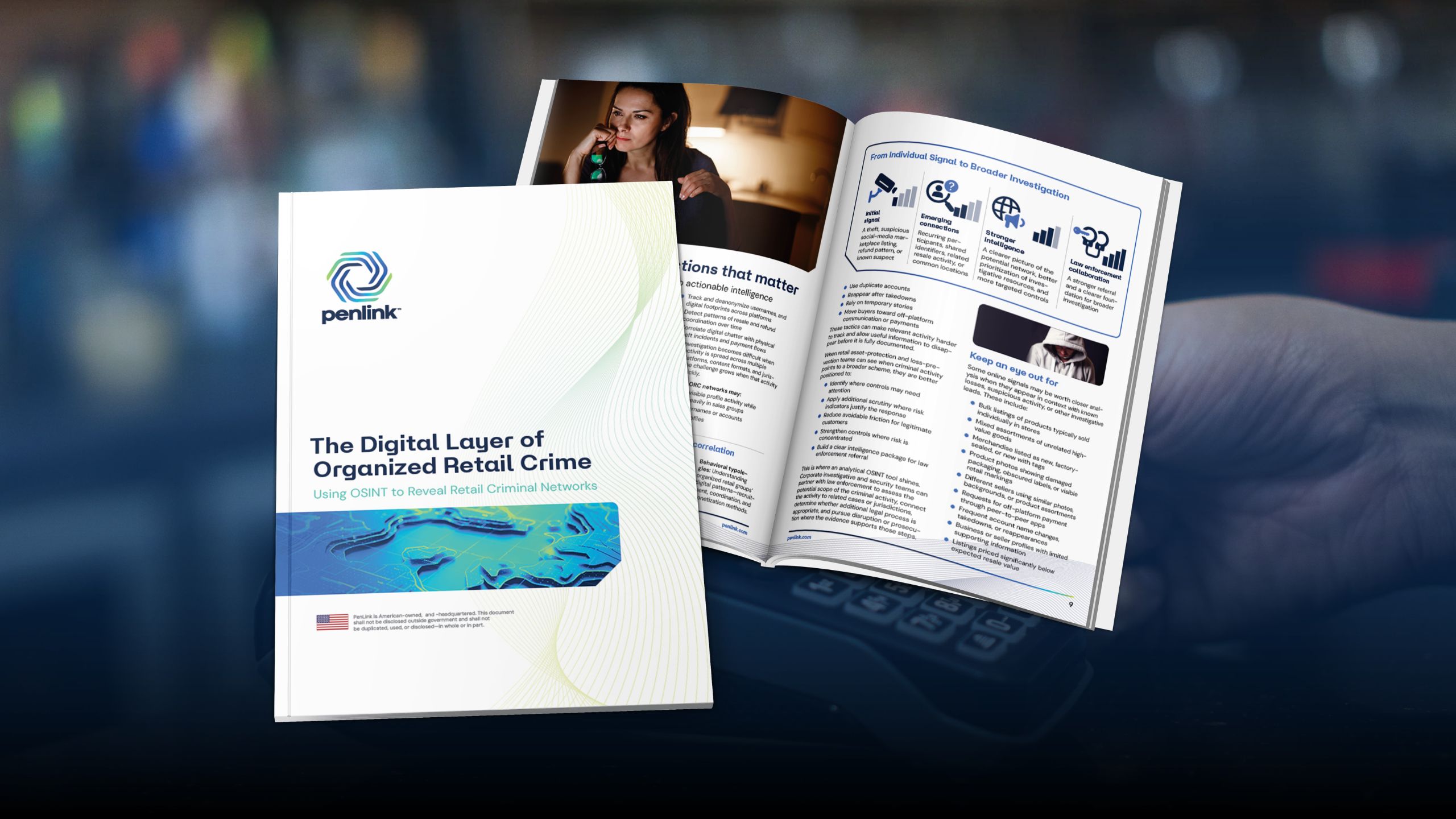
Organized retail crime networks move stolen goods and scale fraud through online marketplaces and messaging channels. This white paper shows how loss-prevention teams can connect individual incidents to the networks behind them.